Too few forklifts mean trailers stacking up at the dock and operators waiting for a truck. Too many means owned equipment sitting idle while maintenance costs keep coming. Both problems cost money every shift.
The good news is that figuring out how many forklifts your warehouse needs takes a simple formula and a few numbers you already track. Here is how to run the math, plan for spares, and cover busy seasons.
Quick Answer:
Most warehouses need enough forklifts to cover the workload of their busiest shift, plus a small buffer of spares. Divide the hours of lifting work per shift by the productive hours one truck delivers in a shift.
Rules like “one truck per 1,000 pallets” are only a starting point. Travel distance, layout, and shift structure change the answer for every building.
The Formula for How Many Forklifts Your Warehouse Needs
Step 1: Count Your Daily Pallet Moves
Every time a pallet is lifted and placed counts as a move. Include receiving, put-away, replenishment, picking, and loading.
Use a typical busy day. Sizing your fleet to a slow day leaves you short when it matters most.
Step 2: Time a Typical Move
Time the full cycle: travel to the load, lift, travel, place, and return. Clock 10 to 20 moves in different parts of the building, then average them.
Step 3: Convert Moves to Work Hours
Use this formula:
Daily pallet moves × minutes per move ÷ 60 = hours of lifting work per day
Divide that number by your number of shifts to get the hours of work per shift.
Step 4: Calculate How Many Forklifts Your Warehouse Needs
An 8-hour shift does not mean 8 hours of lifting. Breaks, shift changes, charging, and waiting at the dock all cut into it.
A conservative planning figure is about 6 productive hours per truck in an 8-hour shift. Swap in your own hour-meter data once you have it. Divide your hours of work per shift by that number, and always round up. Wajax uses a similar formula that factors in moves per hour and utilization.
Pro Tip: Time moves during a real busy shift. Dock congestion and aisle traffic are part of your actual cycle time.
A Worked Example
Here is how the math looks for a sample two-shift warehouse.
| Step | Calculation | Result |
| Daily work | 480 moves × 6 minutes | 2,880 minutes |
| Work hours per day | 2,880 ÷ 60 | 48 hours |
| Work hours per shift | 48 ÷ 2 shifts | 24 hours |
| Trucks per shift | 24 ÷ 6 productive hours | 4 trucks |
| Spare buffer | 15 to 20% of 4, rounded up | 1 truck |
| Total fleet | 5 forklifts |
Change one input and the count shifts. Run all 480 moves on a single shift and you need 8 trucks running at once. Add two minutes of travel to every move and the two-shift operation needs 6 working trucks before spares.
These are sample figures. Your layout and product mix will set your real numbers.
What Changes the Number
Your building affects how many forklifts your warehouse needs as much as your pallet count does.
Layout and Travel Distance
Every extra foot between the dock and storage adds time to every move. Buildings with long runs or docks on one end need more trucks for the same pallet count.
Aisle Width and Rack Height
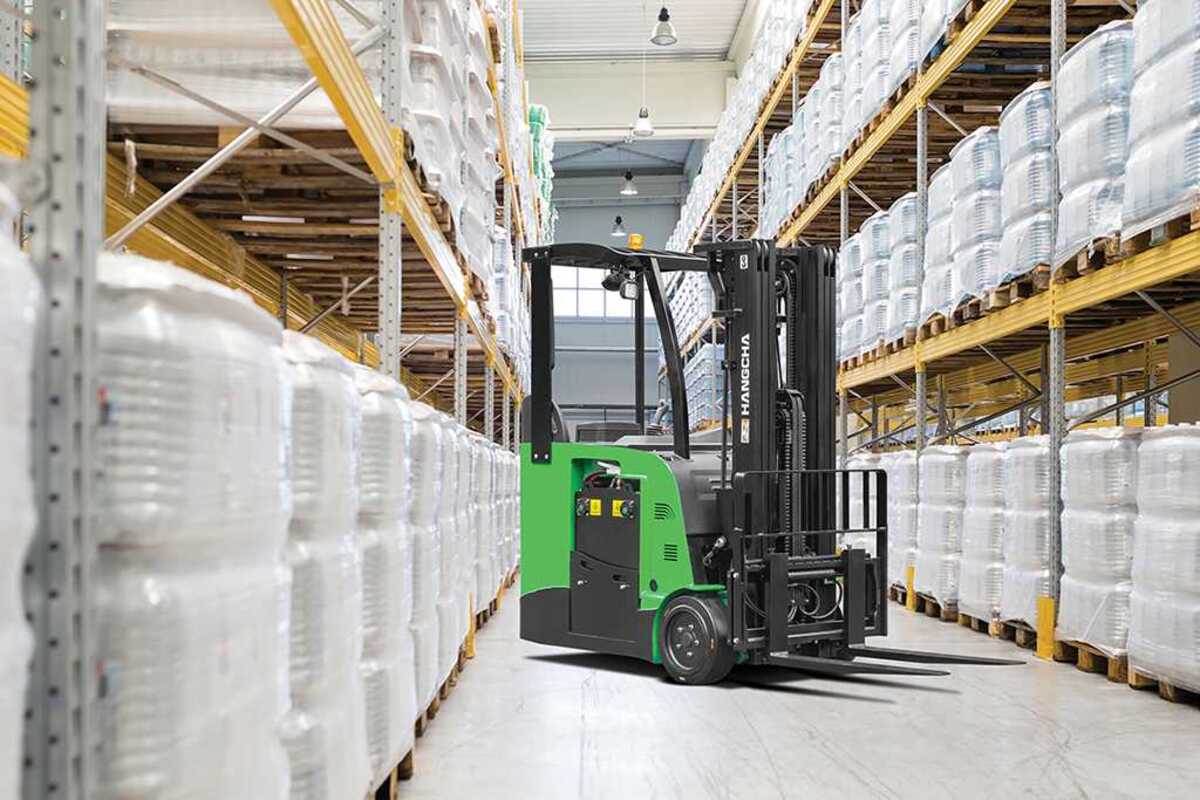
Narrow aisles and tall racking call for reach trucks or order pickers. That changes the mix of equipment as well as the count, so plan how many of each truck type you need.
Load Weight and Product Type
Heavy loads require higher-capacity forklifts. High-volume, light picking may move faster with electric pallet jacks. Our new equipment lineup covers capacities from 2,000 to 100,000 pounds.
Trained Operators
Under OSHA 29 CFR 1910.178(l), the employer must train, evaluate, and certify every operator, and training must cover the types of trucks they will drive. Your fleet can only run as many trucks as you have qualified drivers on each shift.
Battery and Charging Setup
In multi-shift operations, lead-acid batteries often need to be swapped between shifts, which cuts into productive hours. Lithium batteries support opportunity charging during breaks, which can reduce the need for spare batteries and recover some of that time. Learn more about the advantages of lithium batteries.
Key Takeaway: The right fleet is a mix of truck types sized to your actual workflow. A single number from a rule of thumb rarely fits.
How Many Spare Forklifts Should You Keep?
There is no fixed industry ratio. A practical rule of thumb is to add 15 to 20% above your calculated minimum, which works out to about one spare for every 5 to 7 trucks. Where you land depends on two things:
- How fast service arrives. Quick local repair support means you can carry fewer spares.
- How much downtime costs you. If one truck down stops shipping, lean toward more.
Regular planned maintenance also cuts surprise breakdowns, so you can keep fewer spares.
Pro Tip: A short-term rental can stand in for a spare during repairs, so you are not paying to own a truck that sits most of the year.
Signs Your Fleet Is Too Small or Too Large
When You Need More Forklifts
- Trailers wait at the dock
- Operators wait for an open forklift
- Overtime keeps climbing
- Preventive maintenance gets pushed back because no truck can be spared
Signs You Have Too Many
- Several trucks run below about 50% utilization
- Some forklifts sit parked for full shifts
- You are paying to maintain equipment that rarely moves
Utilization is simple to track: divide a truck’s run hours by its available hours. Hour meters work, and telematics systems can log run time and idle time automatically. Compare trucks one by one, since averages can hide idle units.
Not sure where your fleet stands?Contact RDS Equipment, and our team can visit your site and review your current equipment.
Buy, Lease, or Rent for Peak Season
Buy or Lease Your Base Fleet
Size the trucks you own to steady, year-round demand. Used and reconditioned forklifts can stretch the budget, and financing and leasing options help spread out the cost.
Rent for Seasonal Peaks
Holiday surges, inventory counts, and short projects are a good fit for rentals. A short or long-term rental covers extra demand without adding trucks that sit idle the rest of the year. Use our rental request form to check availability.
Key Takeaway: Own the fleet you use every day. Rent the trucks you only need a few weeks a year.
Get the Right Fleet for Your Warehouse
RDS Equipment is a family-owned forklift dealer that has served the Kansas City area since 1998. Sales, rentals, service, and parts all run through one local team, so your fleet plan has real support behind it.
Send us your daily pallet count, number of shifts, and rack layout through our contact page to schedule a fleet review. Our team will help you figure out how many forklifts your warehouse needs.