Damaged product and slow cycle times usually trace back to the same problem: a forklift doing work it was never equipped for. We hear it constantly in our service bay, which is why we want forklift attachments explained in plain terms instead of spec sheet language. This guide covers what clamps, rotators, and fork positioners actually do, what each one costs you in lifting capacity, and how to tell whether your truck can run one.
What Forklift Attachments Do
Every attachment falls into one of two camps. Knowing which camp you are shopping in narrows the field fast.
Attachments That Replace Your Forks
Clamps and rotators take the forks off entirely. They grip, cradle, or spin a load instead of sliding underneath it. These are the tools for product that never touches a pallet.
Attachments That Enhance Your Forks
Fork positioners and sideshifters keep the forks and add hydraulic movement. Your operator adjusts spacing or shifts the load left and right without leaving the seat.
Key Takeaway: If your product moves on pallets, you want an enhancement. If it moves bare, you want a replacement.
Forklift Clamps: Handling Loads Without Pallets
Clamps grip from the sides using hydraulic pressure. They are common in recycling, paper, appliance distribution, and chemical handling.
Carton and Bale Clamps
Carton clamps handle boxed goods, appliances, and furniture with wide flat pads. Bale clamps grip compressed recyclables, cotton, and textiles, and many models rotate so operators can set bales on edge.
Paper Roll and Drum Clamps
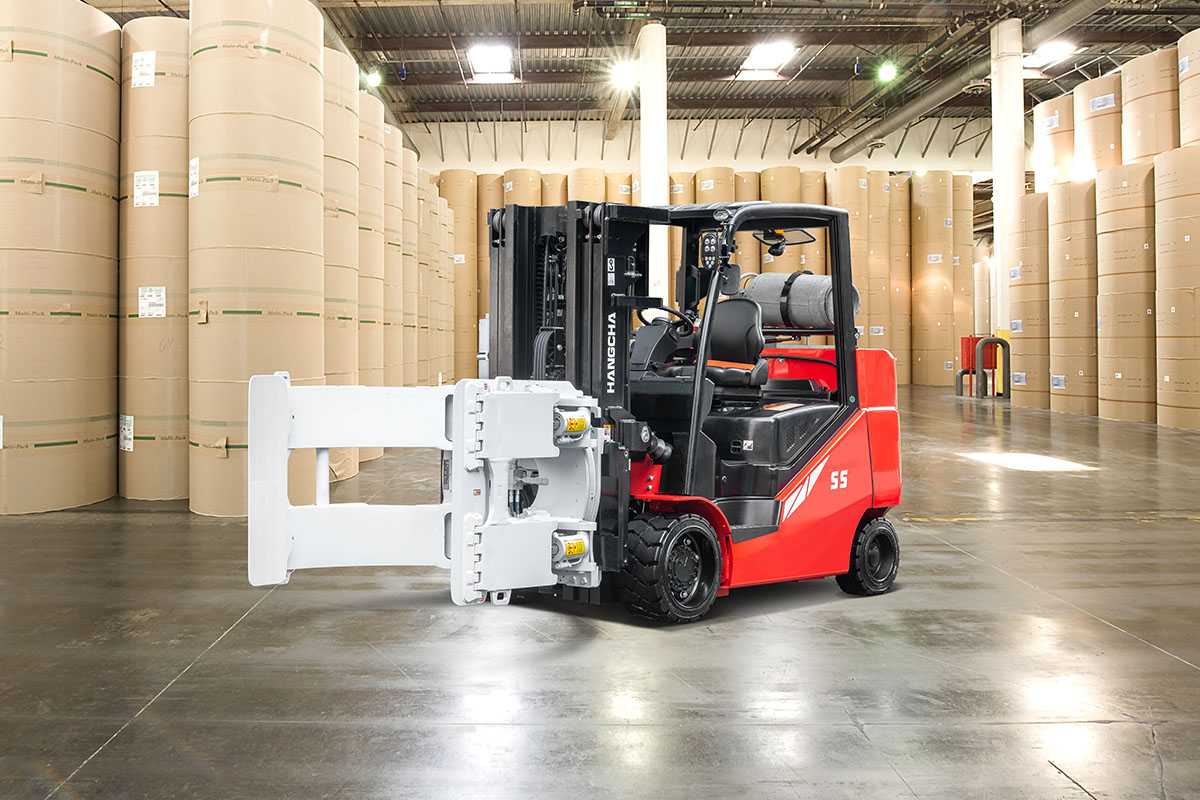
Paper roll clamps use articulating arms that curve around a roll so one operator can move it alone without crushing the core. Drum clamps secure barrels in one to four drum configurations and often tilt for pouring.
Push-Pull Attachments
Push-pull units let you ship on slip sheets instead of pallets. For high-volume food, beverage, and export operations, taking pallets out of the freight cost is often where the savings come from.
Pro Tip: Clamp force set too high crushes product. Clamp force set too low drops it. Ask about a pressure regulator when you spec a clamp, especially for mixed loads where one setting will not work across every SKU.
Rotators: Dumping, Pouring, and Inverting
Rotators turn the entire carriage and load. They show up in food processing, foundries, chemical plants, and any operation emptying bins into hoppers or mixers.
How Rotators Work
A hydraulic motor spins the carriage 180 degrees or a full 360 degrees depending on the model. Continuous rotation costs more and earns it back in operations dumping all shift.
Rotator or Drum Handler?
These get confused often. A rotator spins whatever is mounted to it. A drum handler is purpose-built for barrels and usually tilts rather than fully rotates. Buyers who need both pouring and general bin dumping are typically better served by a carton clamp with integrated rotation.
Fork Positioners: Adjusting Spacing From the Seat
Fork positioners move each fork hydraulically. Operators match pallet width in seconds without dismounting.
Positioner or Sideshifter?
A sideshifter moves the whole carriage left and right for lining up on a pallet. A positioner changes the distance between the two forks. Most of the units we sell are integral sideshifting fork positioners, which do both.
Where Positioners Pay Off Fastest
- Third-party logistics operations handling mixed customer pallets
- Distributors running standard and Euro pallets on the same floor
- Any site where operators currently climb down to move forks by hand
Manual fork adjustment is a back injury waiting to happen and a pinch point every single time. Removing that step is one of the easier safety wins available.
Key Takeaway: If your operators are running more than two pallet sizes, the time they spend adjusting forks by hand is the number to measure against the cost of a positioner.
The Capacity Question Most Buyers Miss
This is where deals go wrong. An attachment changes what your truck can safely lift, and the change is larger than most buyers expect.
Weight and Load Center
The attachment adds its own weight, and it pushes the load center forward away from the mast. Both work against you at once. Calculate the derate before you buy rather than discovering it on the floor.
What Compliance Requires
Adding a front-end attachment generally triggers two obligations. Modifications and additions that affect capacity and safe operation call for the truck manufacturer’s prior written approval, and the capacity plates have to be updated to match. The truck also needs to be marked to identify the attachment and reflect the combined weight of truck and attachment.
That means a new data plate. Our team handles the re-rating as part of installation so you are not left with a truck that fails inspection.
Need help spec’ing an attachment for your fleet? Call RDS Equipment at (816) 221-8825 for a free consultation. We have served Kansas City area operations since 1998.
Forklift Attachments Explained: Will Your Truck Run One?
Before you shop, confirm the truck can support the attachment.
Third and Fourth Function Hydraulics
Standard trucks come with two hydraulic functions for lift and tilt. Sideshift usually needs a third. Clamps and positioners often need a third and fourth. Retrofitting valves and hose reels on an existing truck is routine work for our technicians.
Carriage Class and Fit
Attachments are built to ITA carriage classes, most often Class II, III, or IV. You can identify yours by carriage bar height. Send us a photo and we will confirm it in a few minutes.
Cost, Rental, and Training
Buy, Rent, or Retrofit
Buying makes sense for daily use. Renting makes sense for seasonal peaks, one off projects, or trialing an attachment before you commit. Our rental fleet covers all three situations, and financing is available on purchases.
Used and refurbished units are worth asking about. Clamps and positioners hold up well when they have been maintained.
Training and Maintenance
Operator training requirements are tied to the specific truck and the attachments on it. Adding a clamp means retraining, not just a new part.
Daily inspection should cover hoses, fittings, cylinders, clamp pads, and rotator bearings.
Pro Tip: Attachments change stopping distance and forward visibility. Walk your operators through the differences before the first shift, not after the first near miss.
Talk with Our Team
Why Kansas City Operations Call Us First
We are a family-owned dealership in Independence, Missouri, with field and shop technicians who install and maintain what we sell. That means the people specifying your attachment are the same ones who service it later.
Forklift Attachments Explained for Your Operation
Tell us what you are moving and which truck you are running. We will confirm your hydraulics, spec the right unit, handle the data plate, and get your operators up to speed. Request a quote or call (816) 221-8825 to get forklift attachments explained for your specific operation.